Room temperature
When you right-click a room in the tree structure the following dialog is revealed for definition of the thermal properties of the room when being outside any thermal zone.
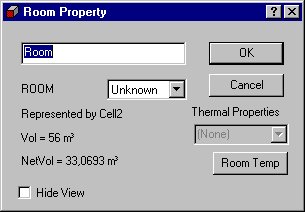
In the selection menu ROOM the condition (Unknown/Heated/Unheated) of the space can be selected. Selection of the space condition is only necessary if the model is to be transferred to the Be18-program for energy frame calculations.
If the space always has the same indoor conditions as a real thermal zone, this zone can be selected from Thermal Properties.
The indoor climate variation in a space can also be described as a cosine shaped variation over the year and day.
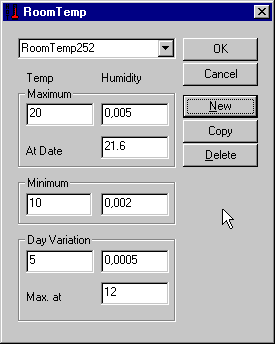
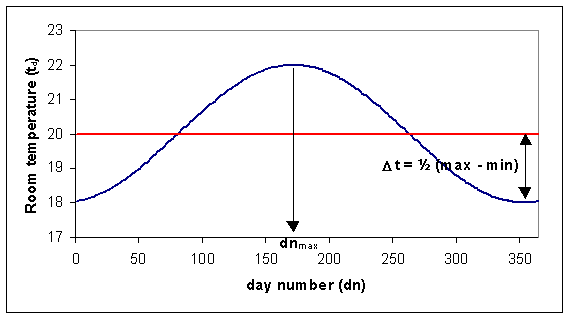
Annual variation of the temperature in a space is calculated as daily average temperatures from:
\[ t_d = t_0 + \Delta t \cdot \left( \cos\left(\left(\text{dn} - \text{dn}_{\text{max}}\right) \cdot \left(\frac{2\pi}{365}\right)\right)\right) \tag{1} \]
where:
t0 is the annual average space temperature in °C,
Δt is the half difference between maximum and minimum space temperature in °C,
dn is the actual day number,
dnmax is the number of the day with the maximum space temperature (i.e. 21. June = 172).
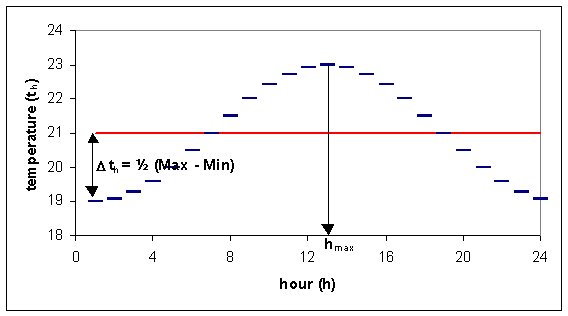
As a daily variation on the calculated daily space temperature, a daily variation can be forced on top of each daily average temperature. The variation is step-wies for each hour:
\[ t_h = t_d + \Delta t_h \cdot \left( \cos\left(\left(h - h_{\text{max}}\right) \cdot \left(\frac{\pi}{12}\right)\right)\right) \tag{2} \]
where:
td is the calculated daily average space temperature for the actual day in °C,
Δth is the half value of the daily variation (Day Variation) in °C,
h is the actual hour,
hmax is the hour where the maximum temperature occurs.
A corresponding variation can be forced on the moisture content in a space.