Ventilation, Inlet Control
Inlet control consists of controlling the supply temperature as a function of the outdoor temperature (climate compensation). The control curve consists of three connected lines and is plotted by defining two points and the slope of the lines outside those points, cf. dialog box graph. The output of the components is controlled in series, with the software trying to achieve the desired supply temperature first by controlling the recovery unit, then the heating or cooling coil.
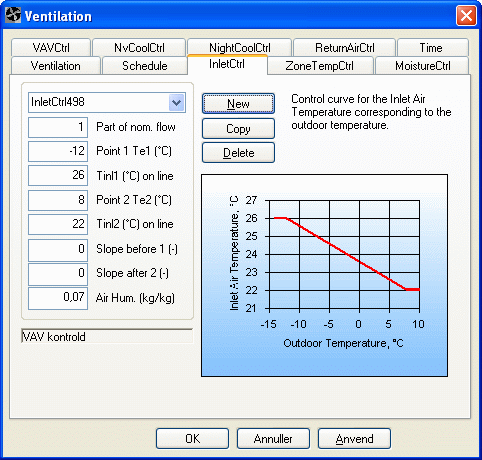
Part of nom. flow: Indicates that the output of the system within the time definition attached to this control action has been reduced in relation to nominal output by the Part of nom. flow factor.
Control curve, Te1, Tinl1, Te2, Tinl2: Specifies the two points of discontinuity (Point 1 and Point 2) for the control curve. In the dialog box graph the points are defined as: (-10, 30) and (10, 17).
Slope before 1 and Slope after 2: Specifies the slope of the lines that make up the control curve at outdoor temperatures below Te1 and above Te2, as shown in the graph. The example in the graph has a slope of 0 before P1 and 0.4 after P2.
Air Hum: Specifies the desired absolute moisture content of the supply air. This parameter is only significant if a humidifier has been defined in the system. Dehumidification will not therefore take place in this type of control.
See also: