Control systems in the multi-zone model
The openings used in the multi-zone model consist of two types. The first type comprises windows and doors (WinDoor) that can be shut and opened as needed. The other type comprises openings that are always fully open when activated.
The control only includes windows and doors. The objective of the control is to get as close as possible to the desired set-points in the individual zones.
Control of openings
The controllable openings can in turn be subdivided into two groups—external and internal. The external openings provide airflow between the thermal zone and the ambient, while the internal openings provide airflow between two thermal zones.
Control of external openings
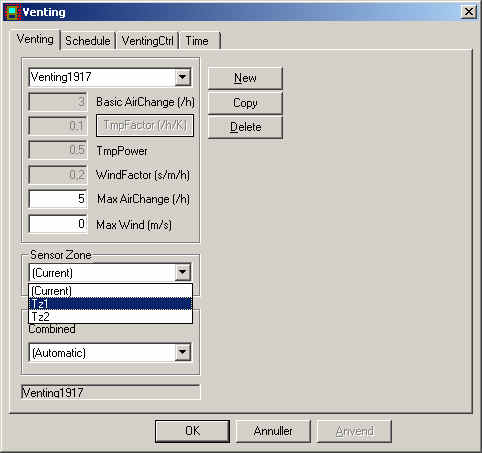
By definition, external openings belong to the thermal zone where they are physically located. As with most other systems in BSim, it is possible to control the openings according to a set-point measured in any thermal zone. Figure 1 specifies which zone the openings are controlled by.
Control of internal openings
The internal openings connect two thermal zones and it is therefore necessary to have a convention governing how they are controlled. The openings are chosen to belong to one of the zones and thus be controlled by it. This was chosen in order to give a simple and unambiguous definition of how the openings are controlled.
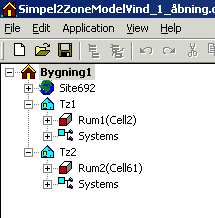
The sequence of the thermal zones in the BSim hierarchical tree structure determines their sequence in the calculation. The sequence was chosen also to be used to determine the ownership of the two internal openings. The thermal zone that is uppermost of the two in the tree structure controls the internal openings between the two thermal zones, Figure 2.
Opening fractions
This section describes how the two types of openings can be controlled.
Opening fraction for controllable openings
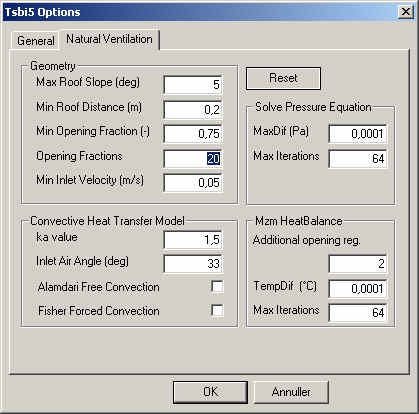
All controllable openings (windows and doors) have an unambiguous number of opening fractions. The number is the same for all controllable openings and the standard number is 20. The number of opening fractions can be changed under tsbi - Edit - Options, Figure 3.
Opening fraction of non-controllable openings
By definition, all non-controllable openings are always fully open. However, they are only active during periods when Venting is activated. When Venting is not activated, tsbi5 calculates as if the openings do not exist.
Calculation sequence for mzm airflow
The calculation sequence for the mzm airflow is as follows:
Decide the demand-controlled airflow
Determine whether air is needed (heat balance with loads, fixed systems)
Determine the directions of the airflows: Multi-zone model with all openings fully open and temperatures and set-points as given by BSim
Determine the desired air volumes: heat balance with airflow directions from the calculation of the multi-zone model.
Adjust the opening fractions to the desired air volumes: change of opening fractions and calculation of air volumes using the multi-zone model with set points from the heat balance until one of the stop criteria has been reached
Find the exact air volumes and temperature with the obtained opening fractions: iteration between multi-zone model and heat balance until one of the stop criteria has been reached.