NvCool regulation, Ventilation
Iver Holm Iversen, IndeKlimaMiljø
The NvCool-control is, like VAV-control, a control strategy based on a space sensor, which is primarily used in rooms that need ventilation and cooling for the major part of their operating time. The NvCool-control was developed in a research project under the Danish EFP programme called "Natural ventilation with heat recovery and cooling." Using natural ventilation, there is no electricity consumption and surplus heat is thus removed — at a higher indoor temperature — by increased airing instead of mechanical cooling of the inlet air.
In the aforementioned EFP project, a system for natural ventilation and cooling has been developed. The exhaust air passes an air-to-fluid heat exchanger with very low pressure loss on the air side. Fluid circulates in the pipes and this heats the air. The fluid is in a closed circuit and passes to a heat pump where it is cooled further before it returns to the heat exchanger. The heat gained from the fluid in the heat pump is transferred to the heating system.
The difference between a VAV-control and an NvCool-control is that the VAV-control increases the air volume linearly at a set point, e.g. 24 °C, while the NvCool-control will start by increasing the air flow exponentially (rapidly at first and then less) and at a lower indoor temperature (e.g. 22 °C). In this way a high air flow is achieved in advance of reaching an over temperature — a kind of "preventive cooling."
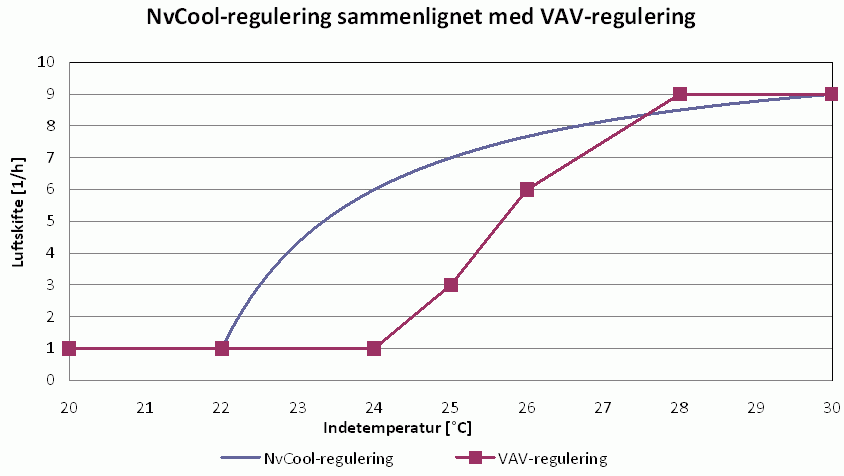
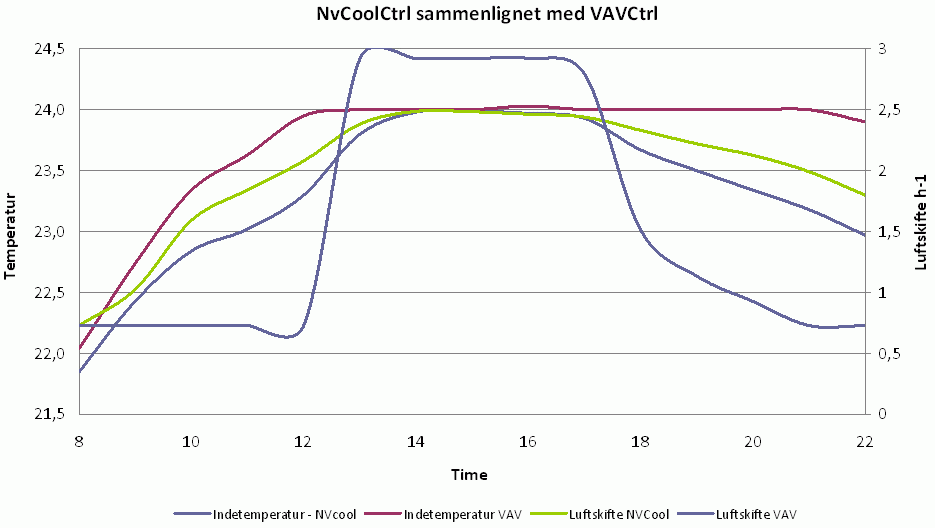
The set point for the NvCool-control is fixed to 22 °C and for the VAV-control to 24 °C. At 22 °C, airing therefore starts with an increased air flow in the NvCool-control, while the VAV-control does not increase the air flow before the indoor temperature reaches 24 °C. It is clear that there is a lower indoor temperature using the NvCool-control than when using the VAV-control, due to the increased air flow. Generally speaking, the NvCool-control uses more air than the VAV-control, but as a consequence less mechanical cooling is needed. In the example above, active cooling of the inlet air is used in the VAV-control while this is not necessary using the NvCool-control.
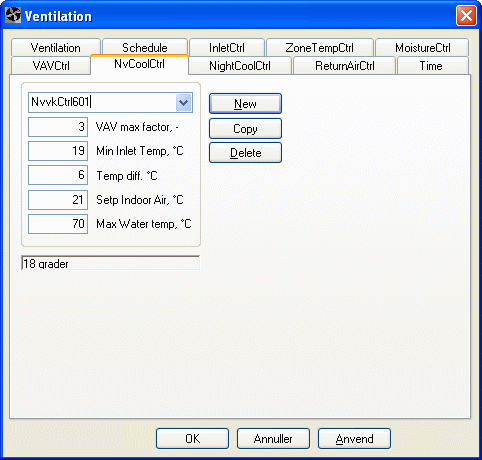
VAV, max factor [-]: Volume flow (nominal) given as a factor for 'ventilator' that can be used to increase the nominal air flow (≥ 1). Normally the factor will be between 1.5 and 3.0.
Min Inlet Temp. [°C]: The parameter Min Inlet Temp defines the lower limit for the inlet temperature.
Temp. diff. [°C]: Defines a limit for the maximum allowed temperature difference between the inlet air and the indoor air temperature. This is useful to avoid problems with draft.
Setp. Indoor air, [°C]: Set point for the space sensor for activating the increased air flow. In case of heating demand, the system will supply the nominal (minimum) air flow. If the set point is exceeded, the air flow increases exponentially as shown above.
Max Water temp. [°C]: Defines the highest allowed fluid temperature at the heating coil. In the results file the actual fluid temperature to the heating coil is shown. The heating coil can work as a cooling coil during summer (cooling) periods as cooled fluid can circulate through the heat exchanger. The flow temperature for the cold fluid is saved in the results file as NvWaterTemp. The yield from the heating/cooling coil is based on practical experiments with a Comfort 100 unit.