The Kappa Model - model description
If the temperature of the exhaust air from a room is known (e.g. using a thermal balance based on complete mixing of the room air), the vertical temperature distribution can be determined approximately using the following model provided the room's geometry and heat sources are known.
Prerequisites
The vertical temperature distribution is very much dependent on the flow field. If the room air is close to being fully mixed, there will be no particular temperature gradient, whereas stratified flow such as that generated by displacement ventilation could create a substantial gradient.
In naturally ventilated rooms where the height of the room is limited (e.g. less than 2.5 m), the temperature gradient will normally be insignificant in winter, while summer conditions might create a slight gradient. In the case of high rooms both winter and summer conditions could give rise to temperature gradients, particularly if the inlet apertures are positioned low down and the outlet apertures high up. A multi-story building with relatively large openings in a vertical direction can have a virtually uniform temperature distribution on each story and at the same time a gradually rising vertical temperature for the building as a whole.
The following method assumes that there is a stratified flow field. It also assumes that any horizontal temperature gradient there might be can be ignored.
Description of the simple model
A simplified procedure is used to determine the vertical temperature gradient, with the actual temperature profile being modeled with an approximated linear profile. The gradient is determined on the basis of knowledge of the heat sources, for example, cf. table 1.
For high rooms with heat sources positioned on several levels, the linear vertical temperature profile described by the "Kappa Model" will often be a very rough approximation. If, in the case of displacement-ventilated rooms, there is a substantial deviation from those situations where κ can be set to 0.5, κ should be chosen on the basis of air flow considerations.
Please note that in some cases a useful approximation of the temperature gradient's progression can only be obtained by introducing a partially linear temperature profile, something which the "Kappa Model" in its present form is not capable of.
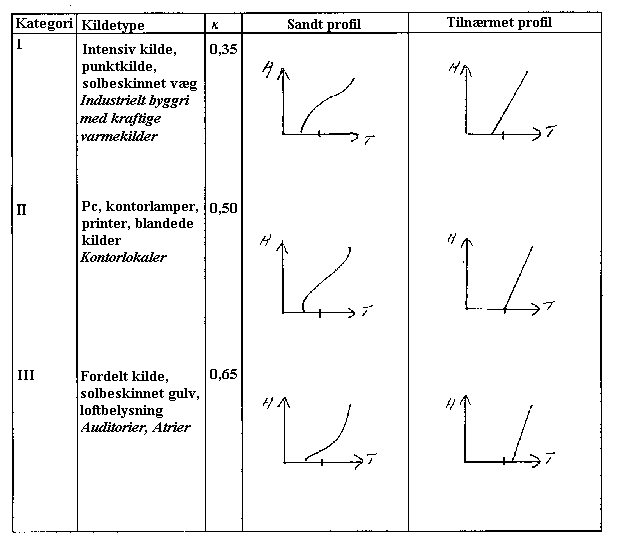
If the heat sources are known, κ can be found. In this case the temperature at floor level and the vertical temperature gradient are determined using
\[ T_f = T_0 + \kappa (T_R - T_0) \tag{1} \]
where
Tf is the air temperature at floor level (°C)
T0 is the supply temperature (°C), cf. section 3
TR is the temperature of the exhaust air (°C)
and therefore
\[ \kappa = \frac{T_f - T_0}{T_R - T_0} \tag{2} \]
Assuming full mixing, TR can be found using
\[ T_R = T_0 + \frac{\Phi_{konv}}{\rho c_p q_v} \tag{3} \]
where
Φkonv is convective thermal load (W)
ρ is density (kg/m³)
cp is thermal capacity (J/kg °C)
qv is air flow (m³/s)
Dimensionless form produces the following expression:
\[ T^* = y^* (1-\kappa)+\kappa \tag{4} \]
where y** is the dimensionless height and T** is the dimensionless temperature
\[ y^* = \frac{y}{H} \tag{5} \]
\[ T^* = \frac{T - T_0}{T_R - T_0} \tag{6} \]
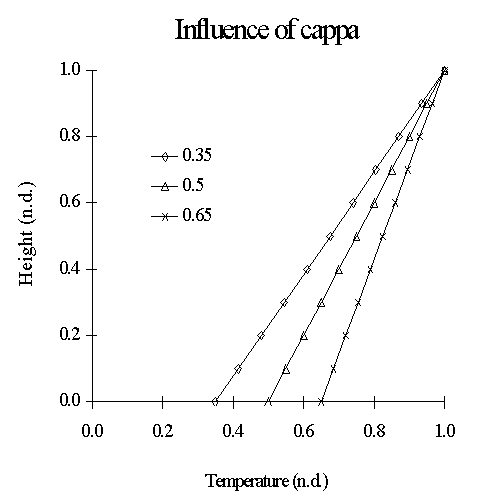
At floor level y** = 0 and T = κ . At the ceiling *y = 1 and T* = 1.
If κ = 0.5 this method corresponds to the "50% rule", a rule of thumb often used when dimensioning displacement ventilation (Skistad, 1994). For fully mixed room air κ = 1.0.
If the expression is written directly, the vertical temperature as a function of height is obtained:
\[ T = T_0 + (T_R - T_0) \left( \frac{y}{H} (1-\kappa)+\kappa \right) \tag{7} \]
Figure 1 shows a dimensionless representation of the vertical temperature profile for the three cases in table 1.
In practice it should be possible to estimate κ based on a knowledge of the heat sources in a given room where there would be a stratified flow in accordance with the aforementioned prerequisite. If measurements or experience of the temperature progression are available, the value of κ that gives the best linear approximation of the true temperature profile is used.
Another option is to "calibrate" the temperature progression interactively using CFD simulation. First a value of κ is estimated, enabling BSim to calculate the convective heat flow from the internal surfaces. The heat flows are used as a boundary condition in the CFD simulation, which returns the vertical temperature progression, which can now be used to correct the value of κ first estimated, and so on.
See also: